
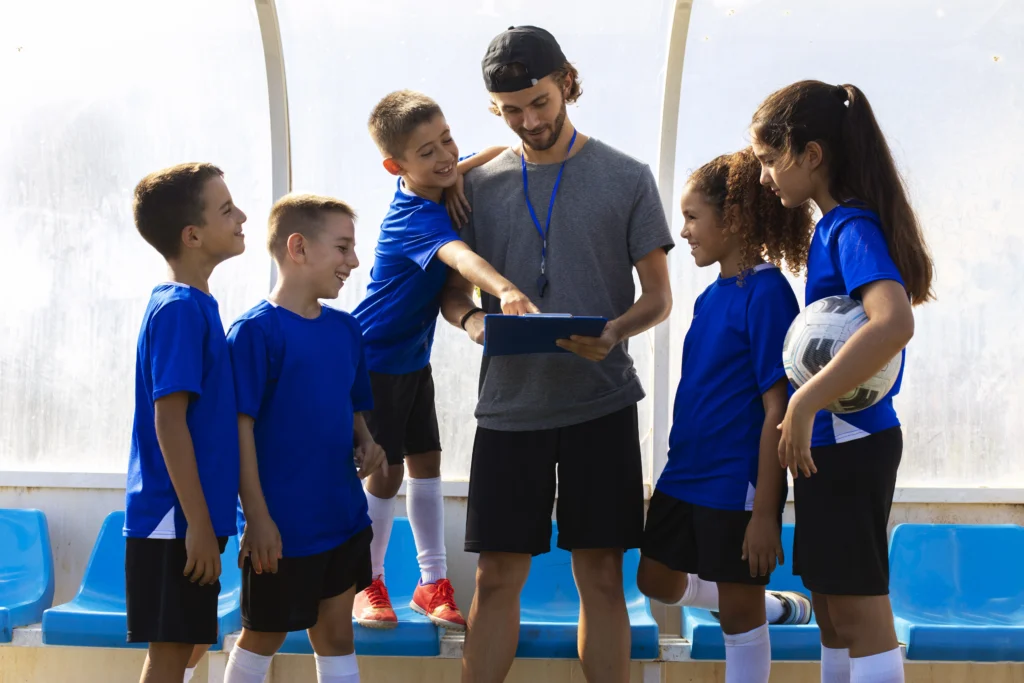
Beyond teaching physical skills, sports academies shape well-rounded individuals. They create effective learning environments for children by combining structured physical training and mentorship.
Key Takeaways
- Holistic Development: Sports academies go beyond physical conditioning to cultivate essential life skills like teamwork, resilience, and emotional intelligence.
- Building Confidence: By providing a structured, safe environment to learn from mistakes, these programs help children transform failure into lasting self-belief.
- Leadership Foundation: Through consistent practice in communication, strategic decision-making, and goal-setting, sports training naturally shapes young athletes into capable leaders.
The UAE has one of the most competitive academic environments in the world. Contrarily, more than one-third of children spend more than seven hours every weekday on screens. Getting involved in organized sports helps children to deal with the screen addiction problem. Sports academies build unwavering self-esteem and leadership to children by teaching resilience and communication.
In this blog, we will evaluate how sports academies contribute to building leadership skills and confidence among children.
How Sports Build Confidence in Children?
Self-confidence in children refers to their quiet inner belief in their own capabilities. Not only in sports, a child needs confidence in every aspect of life. Sports academies build confidence among children via:
Teamwork
Teamwork is a vital skill that can be learned at an early age. A common way to build this skill is to let children play team sports. The U6 Mixed program of Jam Sports Academy allows children under six years to learn and play basketball.
While playing together, they focus on achieving a specific goal. This builds confidence among them, which helps in game improvement. With the teamwork skill, children gain confidence both in the team and also within themselves.
Competence
Sports academies focus on building game-specific skills among the players. Like, the main skills required to play basketball are dribbling, passing, shooting, defense, and rebounding. A basketball sports academy in Dubai ensures that the learners achieve these skills so that they become competent in the sport.
With the development of skills, a child feels confident about his or her game. In addition, the individual also becomes self-confident and that helps in real life also. This makes them realize how hard work drives results.
Resilience
What sets sports apart is that learners learn how to stay resilient. They obtain a safe environment to experience defeat and mistakes. Hence, they accept failures easily. With a range of swimming programs, we ensure that children learn this skill.
Win and lose are part of any sport. Well, a lost match is a stepping stone for improvement. Accepting it nicely builds self-confidence within a child. Therefore, he or she can try again with greater enthusiasm.
How Sports Teach Leadership Skills Among Children?
Engaging in sports training in Dubai improves leadership skills among children. This is achieved via:
Communication and Active Listening
It goes without saying that players need to interact among themselves frequently in a team sport. Referring to basketball, on-court communication is real, immediate, and high-stake. Here, a child learns to offer and obtain instructions clearly.
There is a need for two-way communication in sports. While building effective communication skills, a child is capable of guiding, inspiring, and managing others. This transforms a person to a true leader who fosters trust, creates strategic alignment, and converts complex goals into actionable efforts.
Decision-Making
The cornerstone of success in sports is decision-making. A right decision can make you win a tough match and vice versa. By making children participate in different mini programs and leagues, Jam Sports Academy builds this skill among the children. This makes them grow as a leader because making the right decision defines a leader’s capability.
Goal-Setting
Sports academies offer seasonal training programs to the players. This contributes to making short, medium, and long-term goal structures.
Children learning to set and accomplish goals can transfer this behavior to personal ambitions and academic performance. This indicates how sports academies contribute to different areas.
Empathy and Emotional Intelligence
By making a group of children play together, sports training institutes ensure learners build empathy. This helps them read emotions, celebrate teammate’s success, and support struggling peers. This set of behaviors help develop leadership skills.
While building emotional intelligence in basketball training for kids, individuals inspire and influence others. This is a sign of true leadership. Our multicultural teams account for developing an effective cross-cultural empathy.
How Confidence and Leadership Develop in Different Stages?
The leadership skill of a 7 years old basketball player will not be the same with a 12 years old player. Here is an age-by-age guide.
| Age range | Main development focus | Contribution of sports |
| 5 to 8 years | Self-trust, making friendship, and motor skills | Safe skill repetition, coach praise, and play-based confidence |
| 9 to 12 years | Team identity, social confidence, and resilience | Peer coaching, team membership, and competitive matches |
| 13 to 17 years | Leadership identity, goal-setting, and pressure handling | Captaincy roles and big tournaments |
Table 1: Age-by-age guide on building confidence and leadership
What are the Top Signs that Indicate that a Child is Growing in Confidence and Leadership?
Here is a parental guide on signs that their child is becoming more confident and obtaining leadership abilities.
| Signs | What to see |
| Early signs | Asking to attend to training without prompting Referring teammates by nameMaking better eye contacts in conversations |
| Developing signs | Recovering from mistakes quicklySetting personal goals Defending opinions in team meetings |
| Leadership indicators | Helping junior or new teammates Showing composure in high-pressure match situations |
Table 2: Key signs of developing confidence and leadership ability
To Conclude
Sports academies develop teamwork, communication, decision-making, etc. to make children become more confident and achieve leadership ability. Enrolling in a renowned sports academy ensures the right development of your child.
Give Your Child The Confidence to Lead
We are a leading sports academy in the UAE. We provide professional coaching and structured programs to people of all ages and abilities. Get your child enrolled and obtain expert coaching to build confidence and improve leadership skills.
Frequently Asked Questions (FAQs)
1. What is an Ideal Age for a Child to Join a Sports Academy?
Children can begin structured sports programs at the age of five years because foundational motor skills and social readiness emerge at this stage. Jam Sports Academy offers sports programs from early childhood to age 17. Age is not the factor. All you need to do is to find the right sports academy in Dubai.
2. Can an Introvert Child Become More Confident while Enrolling in a Sports Academy?
In short, yes. A structured sports environment is effective for an introverted child because it provides a predictable social context. Sports offer specific rules, roles, and team relationships to such children that make social interaction feel manageable. This helps them to improve their self-esteem.
3. Can a Child with no Prior Sports Experience Join a Sports Academy?
There is no need for any prior sports experience to enroll in a sports academy. At Jam Sports Academy, our ‘Everyone Can Play’ philosophy is designed to welcome children at every level. We even allow complete beginners to enroll with us. We have qualified coaches to identify the starting point of a child.
4. My Child is not Naturally Athletic. Can Sports Academies Build Confidence?
Yes, they can. This is because building confidence in sports is not only about winning. It’s about personal growth, physical literacy, learning from failures, and capability to bounce back. Sports academies that celebrate efforts and personal bests over raw talent are good for non-athletic children.
5. How Sports Academies Teach Kids to Handle Failure?
Losing is an inevitable part of sports. Coaches consider losses as teaching moments to evaluate what went wrong. They do not blame anyone. They motivate the team members to learn from the failure and focus on winning again.